
The Problem: Under-Mixing vs. Over-Mixing
The goal of the mixing cycle is not just to distribute ingredients, but to activate the bentonite. This requires energy and time to shear the clay platelets and force water between them to create the binding gel.
- Under-mixing: Results in “latent clay.” You are paying for bentonite that isn’t working because it hasn’t been fully plasticized. This leads to friable edges and erosion defects.
- Over-mixing: Wastes electrical energy, slows down the molding line, and increases sand temperature (due to friction), which accelerates evaporation and requires higher moisture additions.
Why Wet Tensile Strength (WTS)?
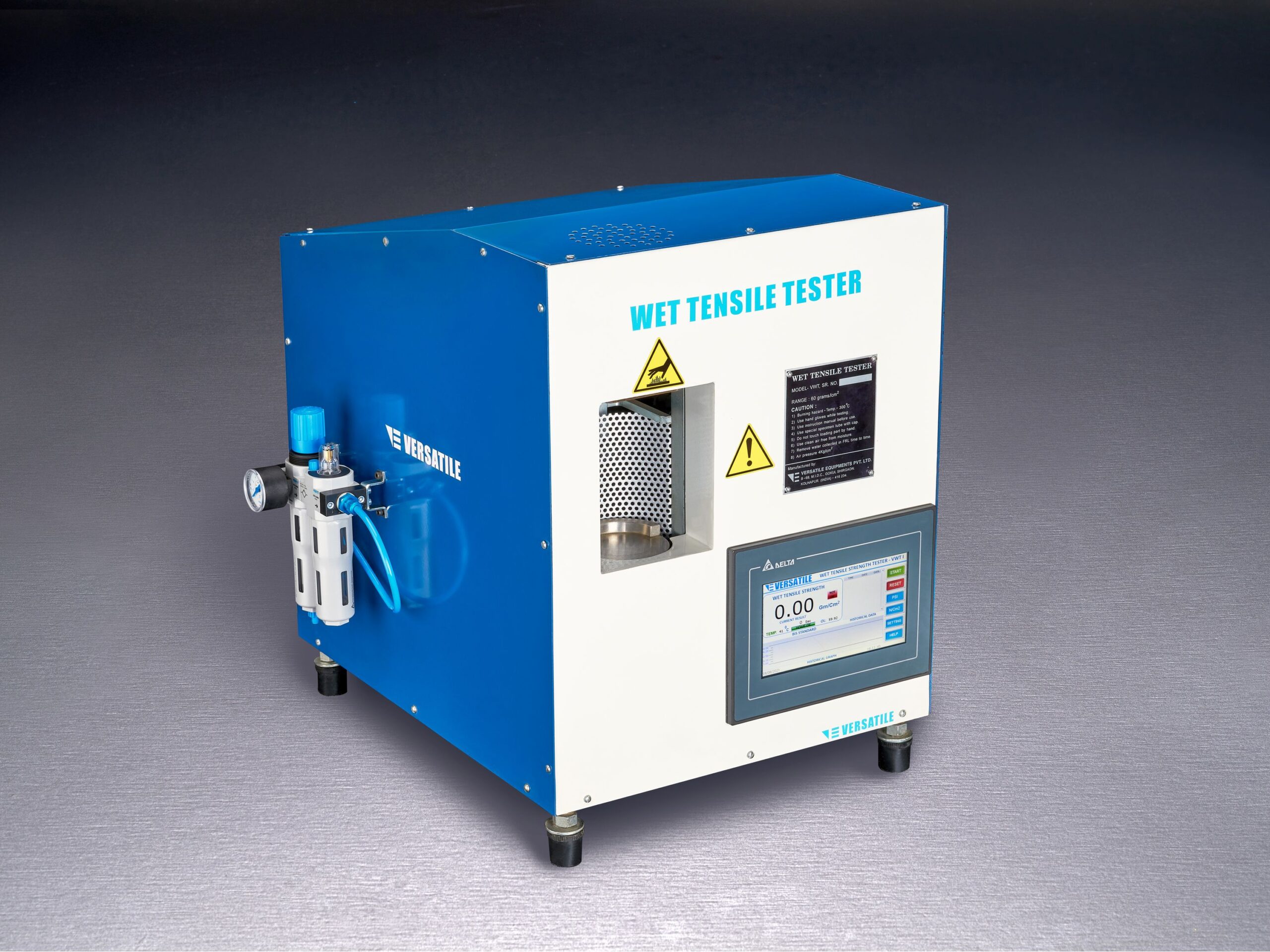
While Green Compression Strength (GCS) and Compactability are standard control parameters, Wet Tensile Strength is uniquely sensitive to the quality of the clay activation.
WTS measures the strength of the sand in the “condensation zone”—the weak, super-saturated layer that forms behind the mold face during pouring. High WTS correlates directly with the bentonite’s ability to resist scabbing and expansion defects. Crucially for mixing, WTS rises sharply as the clay activates and creates the necessary “bridges” between silica grains.
The Optimization Protocol
To find the optimal mixing time, you must perform a Saturation Curve Study.
1. Preparation
Ensure your return sand is consistent. Do not run this test during a start-up or a product change. You want the only variable to be the time inside the muller/ mixer.
2. The Sampling Procedure
Run a standard batch. Instead of dumping the batch at the normal time, extend the cycle and take samples at fixed intervals directly from the muller/ mixer (carefully) or by stopping the muller/ mixer.
- Sample 1: 45 Seconds
- Sample 2: 60 Seconds
- Sample 3: 90 Seconds
- Sample 4: 120 Seconds
- Sample 5: 150 Seconds
- Sample 6: 180 Seconds
Note: Adjust intervals based on your current cycle time. If your current cycle is 120s, you need data points before and after.
3. Laboratory Testing
For every sample collected, immediately test for:
- Moisture & Compactability: (To ensure the sand state is comparable).
- Wet Tensile Strength (WTS): The primary metric.
- Green Compression Strength (GCS): As a secondary reference.
Interpreting the Data: Finding the “Plateau”
Plot the Mixing Time (X-axis) against the Wet Tensile Strength (Y-axis).
You will typically observe one of three curves:
-
The Steep Climb (Under-mixed): If the WTS is still rising significantly at your current set time (e.g., 90s), you are dumping the batch before the clay is fully activated. You are wasting bentonite.
- Action: Increase mixing time OR improve muller/ mixer efficiency (plough adjustment).
-
The Plateau (Optimal): The curve rises and then flattens out. The point where the curve flattens is your Maximum Potential.
- Optimization Strategy: Identify the time where you reach 90-95% of the maximum plateau value. Mixing beyond this point yields diminishing returns—you are spending energy for negligible strength gains.
-
The Drop-off (Over-mixed): If the curve rises and then begins to fall, the friction heat is drying out the sand faster than the bond is improving.
- Action: Reduce mixing time immediately.
Practical Application: The ROI
By identifying the exact minute/second where the WTS plateaus, you can reprogram your PLC timers.
- Scenario A: You find you reach 95% activation at 80 seconds, but you run for 100 seconds. Reducing the cycle by 20 seconds increases your plant’s potential throughput by 20% and reduces energy consumption per ton.
- Scenario B: You find you are under-mixing. Extending the cycle by 15 seconds allows you to reduce your bentonite addition by 0.5% while maintaining the same strength properties.
Conclusion
Optimizing mixing time is not a “set and forget” activity. As muller/ mixer ploughs wear down or sand-to-metal ratios change, the activation efficiency changes. Using Wet Tensile Strength as the benchmark ensures that the sand plant is driven by data, not by habit.